Medica
Fixing the foundation of Indonesia’s health ecosystem, so that everyone has one centralized medical record that any health platform can access.
I started from my own frustrations with healthcare.
This case study began with personal experience of using health services. Three moments kept coming back:
- Having to remember or carry a medical record number, especially at doctors in solo practice who still run a manual system.
- Not remembering which drug I am allergic to. I had a reaction once, but forgot the name of the medicine.
- Registering by phone, then arriving at the hospital to find the doctor had already gone home, because customer service never registered me.
In-depth interviews to validate the assumptions.
The research objective was to understand what people expect from a hospital or health service. Three questions guided the interviews:
- What pain points or obstacles have you run into?
- What do you consider when choosing a hospital?
- What do you expect from a hospital or health service?
Who I talked to.
I interviewed three people who had used more than one health facility in the past six months.
Every hospital owns its records, so patients start over each time.
- Every health facility has its own standard operating procedure.
- Each time a patient goes to a different hospital, they must fill in their data again and a new medical record is created. Records are not centralized.
- The hospital owns the medical record.
- People want access to health services to be easier.
- People want a transparent process, for comfort and certainty.
- People worry about switching hospitals because they have to explain their medical history to a new doctor, and they cannot remember all of it.
“The most annoying part is filling in my data again, even though I already did at the same hospital, just a different location.”Mira, 32, homemaker
“I don't want to switch hospitals because I would have to explain my medical record to the new doctor all over again.”Rindy, 31, insurance agent
Problem statement.
Because medical records aren’t centralized, patients start from zero at every new hospital, and doctors treat them without their full history.
When a patient changes hospitals, they must fill in their data again and a new record is created, and the previous record cannot be used as a reference. That is dangerous. A doctor who can’t see a patient’s history, such as a drug allergy, may make a medical error.
One centralized medical record for everyone.
My answer was one centralized medical record that Indonesia’s whole health ecosystem can build on. I set two conditions:
- The Ministry of Health owns the medical record database.
- One national ID number (NIK) has exactly one medical record.
Concept model.
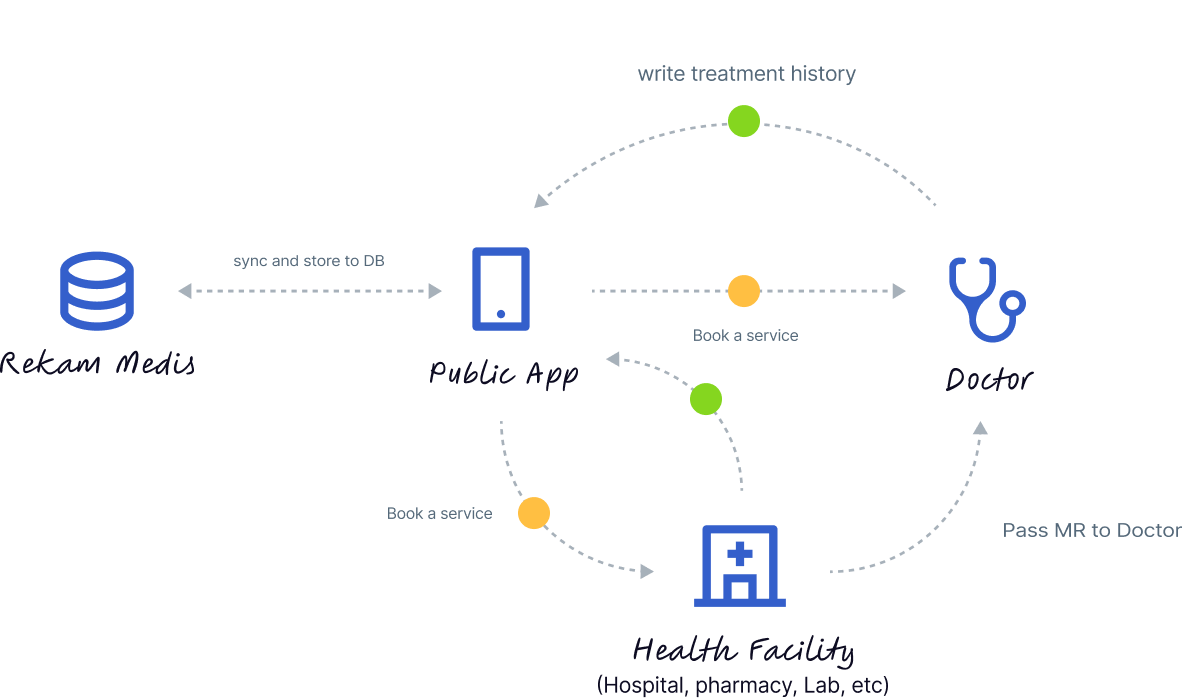
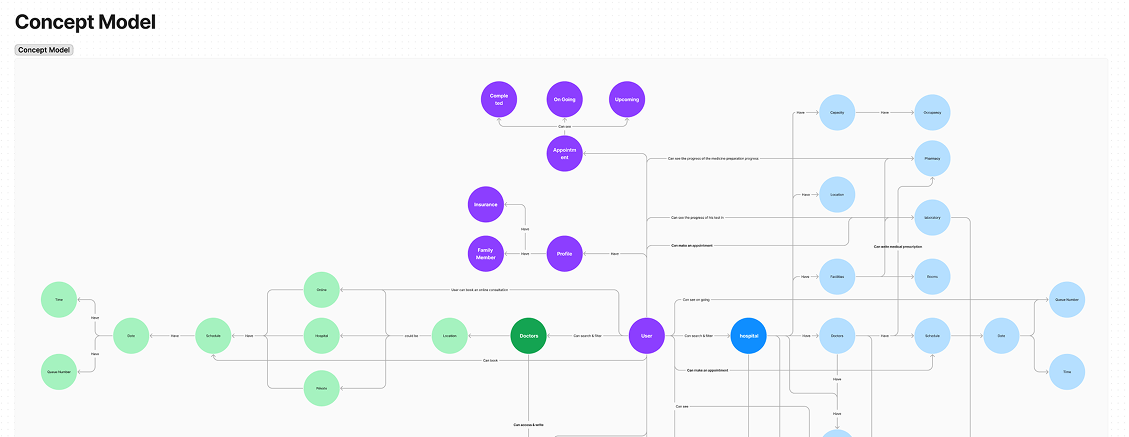
I used a concept model to map how the pieces work together. When a patient books a service, that facility gets access to the record. Hospitals, labs and doctors write each treatment into it, and the system syncs it back to the central database.
Sitemap.
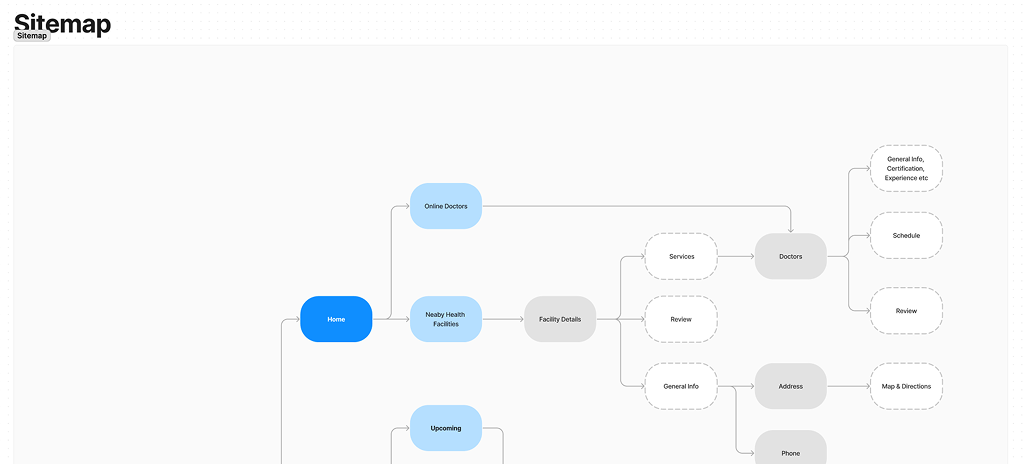
I used a sitemap to map the information structure and decide what each screen should show first.
Expected impact.
Registering at a hospital, in person or online, takes only your ID number. Switching hospitals stops being a worry, because any hospital or doctor who needs your record can open it.
Medica: the app people use to reach health services.
Medica is the patient-facing app in this ecosystem, where people find and book health services. It has six core features.
Easy data entry
Enter your NIK (national ID number) and your details fill in from the population database. If you signed up with an email or phone number, you complete your data once, the first time you book a doctor. After that, booking is just picking a doctor and a time.
Connected to family
One app for the whole family. You can book a doctor's appointment for any family member.
Connected to insurance
Register your insurance and use it as a payment method for health services.
Choose a doctor by preference
Choose with more confidence, based on each doctor’s experience and patient reviews. Book an offline appointment or consult online by chat.
Choose a hospital by preference
Choose a hospital or clinic by the insurance it accepts, along with reviews from other people.
Clear, real-time tracking
Every hospital, lab and doctor writes treatment history into the user's record. Whenever the record changes, the system updates it and shows it in the app.